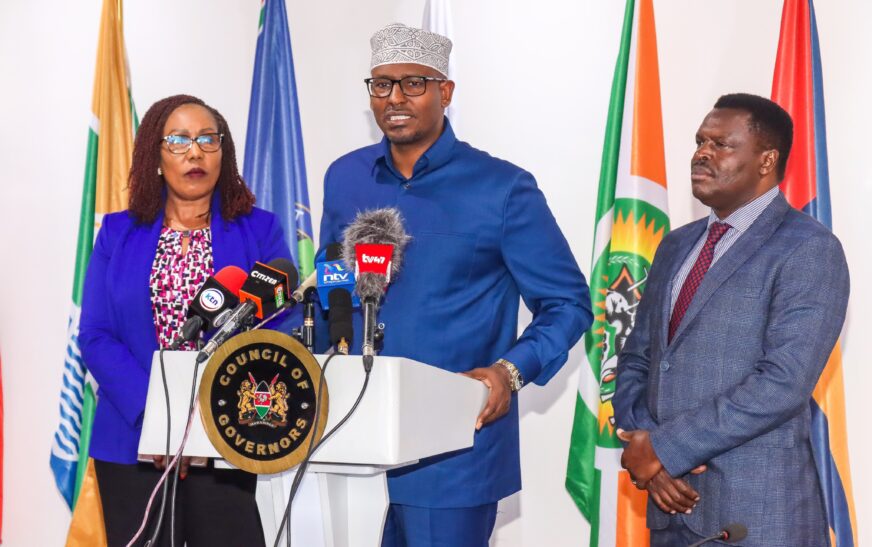

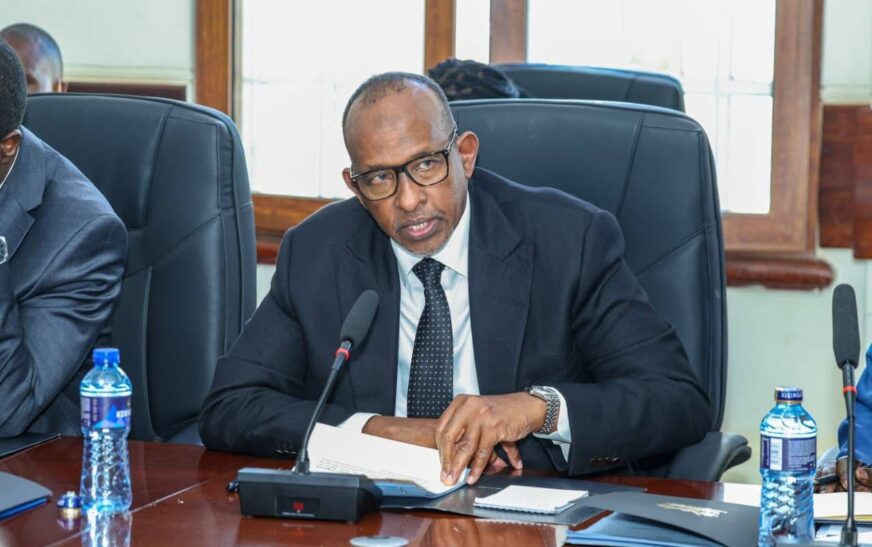
NAIROBI — Health Cabinet Secretary Aden Duale has “sharply” confronted former Deputy President Rigathi Gachagua, demanding concrete documentary proof over allegations of hidden ownership in companies linked to the controversial Social Health Authority (SHA) digitisation project or risk being labelled as resorting to ethnic division rather than facts.
In a public statement titled “Evidence or Ethnic Bigotry: A Challenge to Rigathi Gachagua,” CS Duale accused the former DP of failing to substantiate claims that he holds a 17% stake in Convergence Network Limited, one of the firms allegedly involved in a Sh104 billion IT infrastructure contract for Kenya’s healthcare digitisation under the SHA.
𝗘𝗩𝗜𝗗𝗘𝗡𝗖𝗘 𝗢𝗥 𝗘𝗧𝗛𝗡𝗜𝗖 𝗕𝗜𝗚𝗢𝗧𝗥𝗬: 𝗔 𝗖𝗛𝗔𝗟𝗟𝗘𝗡𝗚𝗘 𝗧𝗢 𝗥𝗜𝗚𝗔𝗧𝗛𝗜 𝗚𝗔𝗖𝗛𝗔𝗚𝗨𝗔 pic.twitter.com/i0SYdXcnF4
— Hon. Aden Duale, EGH (@HonAdenDuale) March 31, 2026
Duale repeatedly challenged Gachagua to produce the official CR12 certificate from the Business Registration Service, a single document that would list shareholders and directors and according to the CS, definitively clear his name.
“When a man has evidence, he produces it. When he has only bigotry, he hides behind ethnic slurs,” Duale declared.
He argued that Gachagua’s refusal to release the CR12 suggests the accusations are not rooted in verifiable corruption claims but in tribal arithmetic aimed at demonising Somali-Kenyan business success.
The dispute centres on a Safaricom-led consortium that includes Konvergenz Network Solutions and other partners for the Integrated Healthcare Information Technology System. Gachagua has alleged that Duale uses proxies, pointing specifically to director Abdullahi Abdi Sheikh of Konvergenz, citing their shared Somali ethnicity as “proof.” Duale dismissed this as “racial bookkeeping,” noting that Konvergenz was incorporated in 2014—long before the current controversy—and that Sheikh holds only a 5% stake through transparent, registered structures.
Cabinet Secretary for Health Aden Duale further referenced Gachagua’s earlier remarks in a Kiambu church linking the BBS Mall in Eastleigh—a major investment planned since 2009—to alleged fraud in Minnesota, USA. He described this as part of a pattern where Somali wealth is portrayed as inherently criminal, irrespective of timelines or documentation.
The Health CS defended the procurement process as a restricted tender under Section 114A of the Public Procurement Act, approved by the National Treasury, evaluated by a committee and recently upheld by the High Court despite Auditor General observations on procedural issues. No court has established fraud or concealed ownership, he emphasised. The arrangement is a lawful IT infrastructure contract not a direct Sh104 billion consortium award to run SHA operations as alleged.
Political analysts note the exchange highlights deepening fault lines in Kenya’s opposition politics. Health CS Aden Duale, however, framed the attacks as an attempt to “burn down bridges between communities” when cornered, drawing parallels to Gachagua’s past rhetoric against other groups.
Duale concluded by urging Gachagua to trace money trails and name companies with evidence rather than substitute document searches with ethnic profiling.
Kenyans await whether Gachagua will respond with the demanded CR12 or escalate the war of words. The episode underscores the delicate balance between legitimate scrutiny of public contracts and the temptation to exploit ethnic narratives in a diverse democracy of 45 million citizens.