

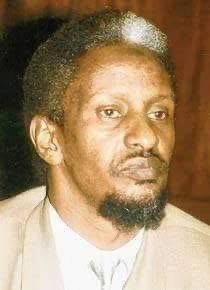
WAJIR— The late Ahmed Khalif Mohamed, former Wajir West MP and Kenya’s shortest-serving cabinet minister, was a prominent member of the Degodia clan—the dominant clan in present-day Wajir County. Born in 1950, he was the son of a police inspector who later rose to become a chief. His elder brother, Abdirashid Khalif, represented the Northern Frontier District at the Lancaster House constitutional talks in the early 1960s.
Ahmed Khalif completed his primary education at Wajir Government School before proceeding to Wajir Secondary School and then to a high school in Nairobi for his secondary studies. He later enrolled at the University of Nairobi, where he pursued a course in journalism. After graduation, he worked as a journalist for the British Broadcasting Corporation (BBC) before entering politics.
In 1979, Degodia elders approached him to contest the Wajir West parliamentary seat after his brother was expelled from the ruling Kenya African National Union (KANU). Khalif agreed, made his political debut that year, and won the election. He was re-elected in 1983.
In February 1984, security forces launched a major operation in Wajir targeting members of the Degodia community, who were accused of involvement in banditry. Hundreds of men were rounded up and detained at Wagalla Airstrip, where a massacre took place—an event that became known as the Wagalla Massacre. Khalif rose in Parliament to condemn the killings, stating that around 1,000 people had died of starvation and exposure in the detention camp. His courageous stand earned him heroic status among the Degodia and Kenyan Somalis broadly.
Khalif also fiercely opposed the government’s requirement for Kenyan Somalis to carry special “Red Cards” as a means of distinguishing them from Somali nationals from neighbouring countries. Viewing the policy as discriminatory and unconstitutional, he retained the services of prominent lawyer Mohamed Ibrahim (who later became a Supreme Court judge) to challenge it in court. The case was successful, further cementing Khalif’s reputation as a resolute defender of Somali rights in Kenya.
In 1992, Khalif briefly joined the opposition, causing alarm in President Daniel arap Moi’s government. Moi personally urged Degodia elders to persuade Khalif to remain in KANU. The elders succeeded, and Khalif rejoined the ruling party, winning the 1992 Wajir West election on a KANU ticket.
His electoral winning streak ended in 1997 when he lost the seat to Safina Party candidate Adan Keynan (the current Eldas MP).
As the 2002 general elections approached, Khalif became actively involved in the Ufungamano Initiative, a civil society movement pushing for comprehensive constitutional reforms. He subsequently joined the National Rainbow Coalition (NARC), a broad alliance of political figures determined to end KANU’s decades-long grip on power. NARC’s decisive victory not only brought the coalition to power but also enabled Khalif to reclaim the Wajir West seat from Adan Keynan. In recognition of his role in mobilising support for NARC in North Eastern Province, President Mwai Kibaki appointed him Minister for Labour and Manpower Development.
Tragically, Ahmed Khalif Mohamed’s ministerial tenure lasted barely three weeks. On 24 January 2003, he perished in a plane crash in Busia County while returning from a homecoming ceremony for former Vice President Moody Awori—just 20 days after taking the oath of office. His sudden death cut short a political career marked by principle, courage and unwavering advocacy for the Somali community.